Email Templates
Bsh Engine allows you to create email templates to send emails to your users, this allow yout to set a templates that you can use to send emails without need to write the email content every time.
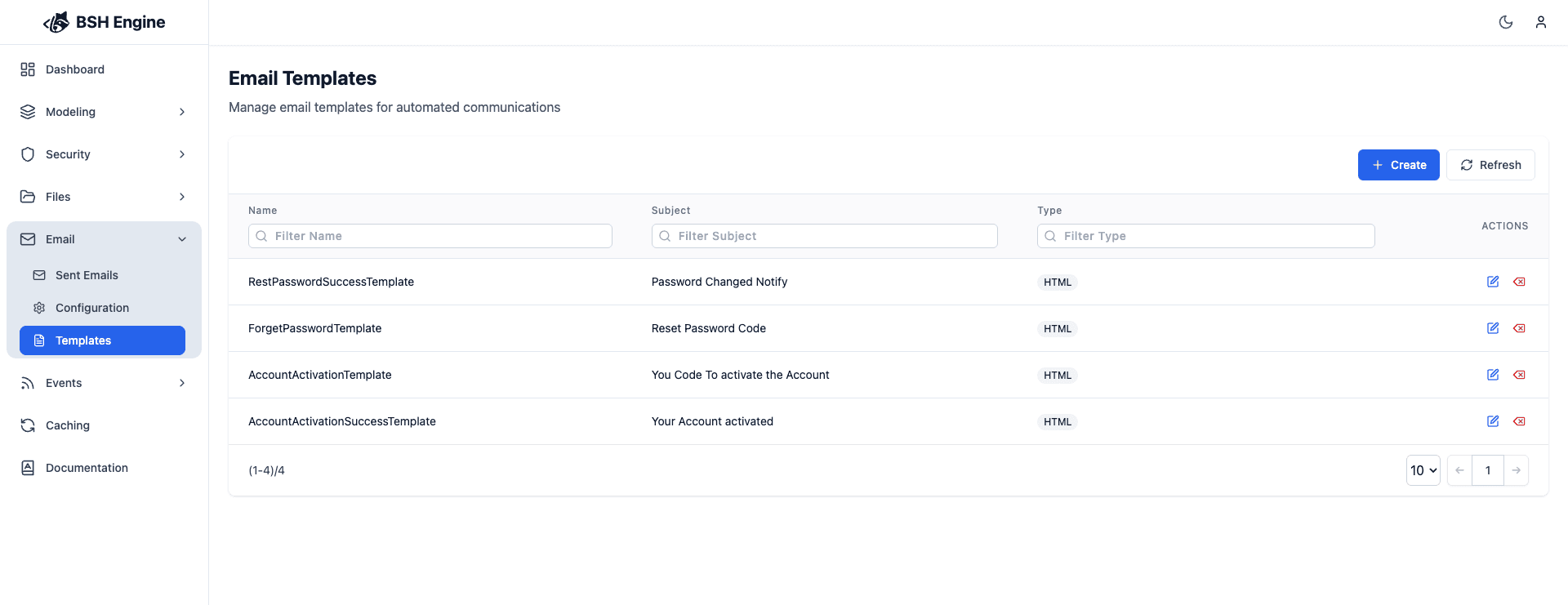
When you start the engine, it will create default email templates for authentication operations (activation, reset password, etc.).
You can edit them to customize the content of the emails.
Create an Email Template
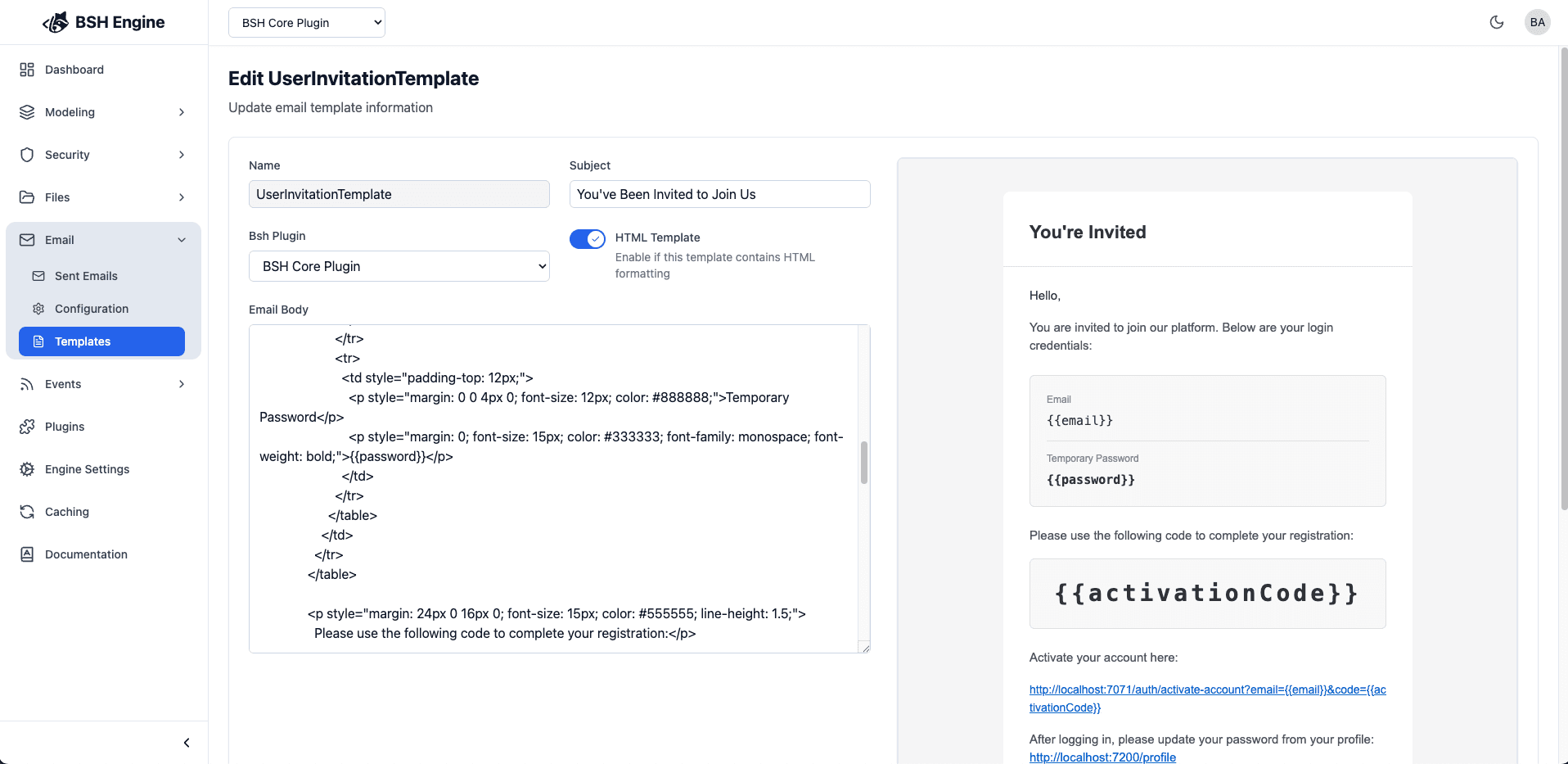
| Property | Description | Required | default |
|---|---|---|---|
| Name | The name of the email template | Yes | ~ |
| Subject | The subject of the email template | Yes | ~ |
| Body | The body of the email template | Yes | ~ |
| HTML | Whether the email template is HTML | No | false |
Template Variables
Bsh Engine allows you to use variables in your email templates to personalize the email content, the syntax is {{variableName}}.
for the authentication operations templates, you can access the user information like this:
Hello {{profile.firstName}} {{profile.lastName}},
Welcome to our application.
Your email is: {{email}} and temporary password is: {{password}}
If you have any questions, please contact us at support@example.com.
When using a templates with variables to send emails, you must pass the data object with the variables values.
Read more about Send Email endpoint.
Authentication Templates
Bsh Engine provides default email templates for authentication operations (activation, reset password, etc.). You can edit them to customize the content of the emails.
Sent when:
- User registers themselves
- Admin initializes a user with a password
Data Object:
{
    "userId": "<user-id>",
    "status": "REQUIRED_ACTIVATION",
    "email": "<user-email>",
    "roles": ["<user-roles>"],
    "profile": {
        "firstName": "<user-first-name>",
        "lastName": "<user-last-name>",
        "...": "..."
    },
    "activationCode": "<activation-code>"
}Sent when:
- Admin initializes a user with an auto-generated password
Data Object:
{
    "userId": "<user-id>",
    "status": "REQUIRED_ACTIVATION",
    "email": "<user-email>",
    "roles": ["<user-roles>"],
    "profile": {
        "firstName": "<user-first-name>",
        "lastName": "<user-last-name>",
        "...": "..."
    },
    "activationCode": "<activation-code>",
    "password": "<generated-password>"
}Sent when:
- User activates their account
Data Object:
{
    "userId": "<user-id>",
    "status": "ACTIVATED",
    "email": "<user-email>",
    "roles": ["<user-roles>"],
    "profile": {
        "firstName": "<user-first-name>",
        "lastName": "<user-last-name>",
        "...": "..."
    }
}Sent when:
- User requests a new activation code
Data Object:
{
    "userId": "<user-id>",
    "status": "REQUIRED_ACTIVATION",
    "email": "<user-email>",
    "roles": ["<user-roles>"],
    "profile": {
        "firstName": "<user-first-name>",
        "lastName": "<user-last-name>",
        "...": "..."
    },
    "activationCode": "<activation-code>"
}Sent when:
- User requests a password reset
Data Object:
{
    "userId": "<user-id>",
    "status": "REQUIRED_RESET_PASSWORD",
    "email": "<user-email>",
    "roles": ["<user-roles>"],
    "profile": {
        "firstName": "<user-first-name>",
        "lastName": "<user-last-name>",
        "...": "..."
    },
    "resetPasswordCode": "<reset-password-code>"
}Sent when:
- User resets their password via the reset password flow
- User changes their password from their profile page
Data Object:
{
    "userId": "<user-id>",
    "status": "ACTIVATED",
    "email": "<user-email>",
    "roles": ["<user-roles>"],
    "profile": {
        "firstName": "<user-first-name>",
        "lastName": "<user-last-name>",
        "...": "..."
    }
}Sent when:
- Admin invites a new user
Data Object:
{
    "userId": "<user-id>",
    "status": "REQUIRED_ACTIVATION",
    "email": "<user-email>",
    "roles": ["<user-roles>"],
    "profile": {
        "firstName": "<user-first-name>",
        "lastName": "<user-last-name>",
        "...": "..."
    },
    "activationCode": "<activation-code>",
    "password": "<generated-password>"
}Sent when:
- A new API key is created
Data Object:
  {
      "id": "<api-key-id>",
      "name": "<api-key-name>",
      "type": "<api-key-type>",
      "status": "<api-key-status>"
}Sent when:
- An API key is revoked
Data Object:
  {
      "id": "<api-key-id>",
      "name": "<api-key-name>",
      "type": "<api-key-type>",
      "status": "<api-key-status>"
}Sent when:
- An API key is deleted
Data Object:
  {
      "id": "<api-key-id>",
      "name": "<api-key-name>",
      "type": "<api-key-type>",
      "status": "<api-key-status>"
  }
Host Variable
you can access host from environment with placeholder {{host}}
